What Happens to Belongings After Crime Scene Cleanup?
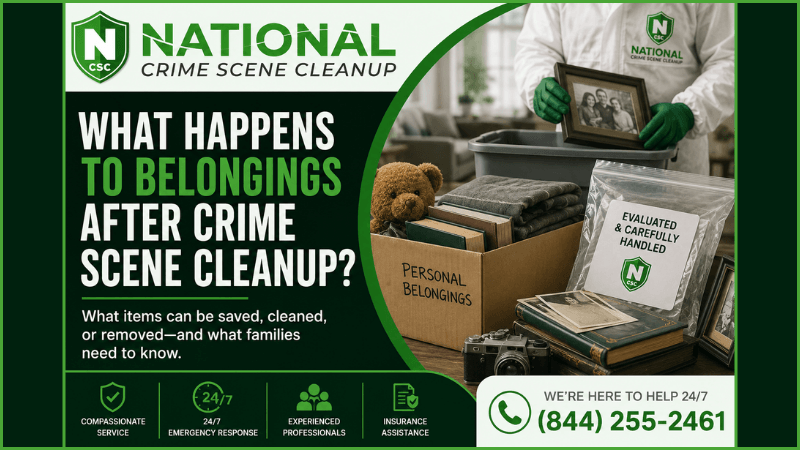
After a crime scene, unattended death, suicide, or other traumatic event, families and property owners often have an immediate concern that goes beyond the affected property:
What happens to the belongings inside?
Furniture, clothing, photographs, documents, family heirlooms, electronics, and other personal possessions may have emotional, sentimental, or financial value. In many situations, people want to know whether these items can be saved before cleanup begins.
At National Crime Scene Cleanup, we understand that personal belongings are often among the most important concerns following a traumatic event.
Whether an item can be cleaned, restored, retained, or needs to be removed depends on several factors, including:
- The type of material
- Whether the item was affected by biological contamination
- The extent of contamination
- Whether the material is porous or nonporous
- How long contamination has been present
- Whether the item can be safely and appropriately remediated
Not every affected item has to be discarded. However, some items may be too heavily contaminated or made from materials that cannot be safely restored.
If you are dealing with a recent incident, call National Crime Scene Cleanup at (844) 255-2461 for 24/7 assistance.
Are Belongings Automatically Thrown Away After Crime Scene Cleanup?
No.
Professional cleanup does not mean that every item in an affected home or property is automatically discarded.
Items should be evaluated based on their individual condition and whether they were affected by contamination.
For example, some belongings may not have been affected at all and may simply need to be protected or moved away from the work area. Other items may be capable of professional cleaning or restoration.
In some circumstances, however, an item may be too heavily contaminated to safely restore.
The important distinction is that cleanup decisions should be based on the condition of the individual item and the extent of contamination, rather than assuming that everything in a room must be removed.
What Happens to Personal Belongings During the Cleanup Process?
Before remediation begins, affected areas and belongings may need to be evaluated to determine what requires attention.
Depending on the circumstances, belongings may generally fall into one of several categories:
Unaffected belongings
Items outside the affected area may not require remediation.
These items can be protected from the work area or left in place, depending on the circumstances.
Belongings that may be cleaned
Some items may be suitable for professional cleaning and decontamination.
Whether this is possible depends heavily on the material and extent of contamination.
Belongings requiring further evaluation
Items with sentimental or financial importance may require careful consideration before decisions are made about cleaning or removal.
Belongings that cannot be safely restored
Some materials may be too heavily affected to retain.
When contamination cannot be appropriately removed, removal of the item may be necessary.
Can Furniture Be Saved After a Crime Scene?
Sometimes.
Furniture is not automatically discarded simply because a traumatic event occurred in the property.
The ability to restore furniture depends on factors such as:
- The material
- Whether contamination reached the furniture
- How deeply contamination penetrated
- Whether the material is porous
- The length of time before remediation
- The overall condition of the item
For example, a hard, nonporous surface may present different remediation considerations than upholstered furniture, cushions, mattresses, or other absorbent materials.
If an item is particularly important to the family, let the cleanup team know before work begins so its condition can be evaluated.
What About Clothing and Personal Items?
Clothing and other personal possessions may have significant sentimental value.
Whether an item can be retained or restored depends on its condition and whether it has been affected by biological contamination.
Items such as the following may require individual evaluation:
- Clothing
- Shoes
- Bags
- Jewelry
- Personal accessories
- Keepsakes
- Children’s belongings
- Sentimental items
If there are belongings you want preserved or evaluated separately, it is helpful to identify those items as early as possible.
Can Photographs, Documents, and Important Papers Be Saved?
Photographs, letters, legal documents, and other important papers can be especially difficult for families to think about losing.
Their ability to be preserved depends on the type and extent of contamination and the condition of the materials.
Important documents may include:
- Family photographs
- Letters
- Birth certificates
- Legal documents
- Financial records
- Insurance documents
- Wills or estate documents
- Identification records
If you know that important documents or photographs are located in an affected area, tell the cleanup team as soon as possible.
This gives the team the opportunity to understand which belongings are especially important to you before remediation decisions are made.
What Happens to Mattresses and Upholstered Furniture?
Mattresses, cushions, upholstered furniture, and similar materials may require additional consideration because they can be porous and absorbent.
Whether an item can be restored depends on factors such as:
- The material
- The extent of contamination
- How deeply contamination has penetrated
- Whether internal materials have been affected
In some situations, visible surface cleaning alone may not address contamination that has reached internal or absorbent materials.
When evaluating these items, the goal is not simply to determine whether the item can be made to look clean. The condition of the material and the extent of contamination must also be considered.
Who Decides What Can Be Kept?
Families and property owners should communicate with the cleanup company about belongings that are important to them.
The cleanup team can evaluate the affected items and explain the remediation considerations involved.
If an item has particular sentimental, historical, or financial importance, it is a good idea to identify it before cleanup begins whenever possible.
This does not guarantee that every item can be restored. However, it helps ensure that important belongings receive appropriate consideration before decisions are made.
Can I Remove Belongings Before the Cleanup Company Arrives?
You should avoid handling or removing items that may be contaminated with blood or other biological materials.
Moving potentially contaminated belongings can:
- Spread contamination to other areas
- Increase exposure to potentially hazardous materials
- Make remediation more difficult
- Affect items that may otherwise have been isolated
If there are important belongings in the affected area, tell National Crime Scene Cleanup about them when discussing the situation.
If you are unsure what to do immediately following an incident, visit our Emergency Resource Center for guidance about the next steps.
What If a Belonging Is Sentimentally Important?
This is one of the most important reasons to communicate with the cleanup team before remediation begins.
Some items have value that cannot be measured financially.
Examples may include:
- Family photographs
- Wedding items
- Children’s belongings
- Heirlooms
- Letters
- Personal collections
- Religious or cultural items
- Items belonging to the deceased
If an item is especially important, let the team know.
National Crime Scene Cleanup can consider the condition of the item and explain the available options based on the circumstances.
The outcome will depend on whether the item can be appropriately addressed, but identifying important possessions early helps prevent misunderstandings about what matters most to the family.
Are Electronics and Devices Treated Differently?
Electronics may require special consideration because contamination and moisture can affect both the exterior and internal components.
Items may include:
- Computers
- Phones
- Tablets
- Televisions
- Cameras
- Other electronic devices
The appropriate handling of an electronic device depends on where contamination is located and whether the device itself has been affected.
If the device contains important information, photographs, or records, tell the cleanup team about its importance before any decisions are made.
What Happens to Belongings That Cannot Be Saved?
In some situations, an item may be too heavily contaminated to be appropriately restored.
When this occurs, removal may be necessary as part of the remediation process.
Before an item is removed, families and property owners should have an opportunity to understand why removal is being recommended whenever circumstances allow.
The need for removal depends on the specific item and situation.
Will Insurance Cover Damaged or Removed Belongings?
Coverage for personal property can depend on the specific insurance policy and circumstances surrounding the loss.
Coverage questions may involve:
- Personal property coverage
- Policy limits
- Deductibles
- Exclusions
- The cause of the loss
- Documentation requirements
For information about cleanup-related coverage, visit: Does Insurance Cover Crime Scene Cleanup?
If you’re navigating an active claim, our guide on How Insurance Claims Work can help you understand the general claims process.
Should I Document Belongings Before Cleanup Begins?
When circumstances allow, documentation can be useful for important belongings and potential insurance purposes.
You may want to discuss documentation with the appropriate professionals involved in your situation, particularly if an insurance claim is being filed.
Depending on the circumstances, documentation may include records of:
- Affected property
- Important personal belongings
- Items requiring removal
- Existing property damage
Do not enter an unsafe or restricted area simply to take photographs or create an inventory.
If the property has not been released by authorities, follow their instructions and do not disturb the scene.
For more guidance about what happens after authorities release a property, read When the Police Leave: What Happens Next?.
How Can Families Protect Important Belongings?
The best approach is to communicate early.
When contacting National Crime Scene Cleanup, tell us about:
- Items with significant sentimental value
- Important documents
- Family photographs
- Heirlooms
- Electronics containing important information
- Items you specifically want evaluated
- Belongings belonging to the deceased
This helps our team understand your priorities as the remediation process is planned.
Frequently Asked Questions
Are all belongings in a crime scene thrown away?
No. Items are not automatically discarded simply because they are located inside an affected property. Each item’s condition and exposure to contamination may need to be evaluated.
Can furniture be saved after blood contamination?
It depends on the type of furniture, its materials, and the extent of contamination. Nonporous surfaces may present different considerations than porous or absorbent materials.
Can photographs be saved after a death?
Possibly. The condition of photographs and the extent of contamination determine what options may be available.
Should I tell the cleanup company which belongings are important?
Yes. If an item has sentimental or financial importance, identify it as early as possible so it can be considered during the planning process.
Can I move belongings myself?
Avoid handling items that may be contaminated. Moving potentially affected belongings may spread contamination or increase exposure.
Does insurance cover damaged personal belongings?
Coverage depends on the insurance policy and the circumstances of the loss. Review your policy and speak with your insurer regarding your specific claim.
Need Help With an Affected Property?
After a traumatic event, personal belongings can represent far more than the items themselves.
If you’re concerned about furniture, photographs, documents, clothing, or other possessions in an affected property, National Crime Scene Cleanup can help you understand the next steps and evaluate the situation as part of the remediation process.
24/7 Emergency Assistance
Call National Crime Scene Cleanup
