Hotel Biohazard Response Plan: A Practical Guide for Hotel Staff and Management
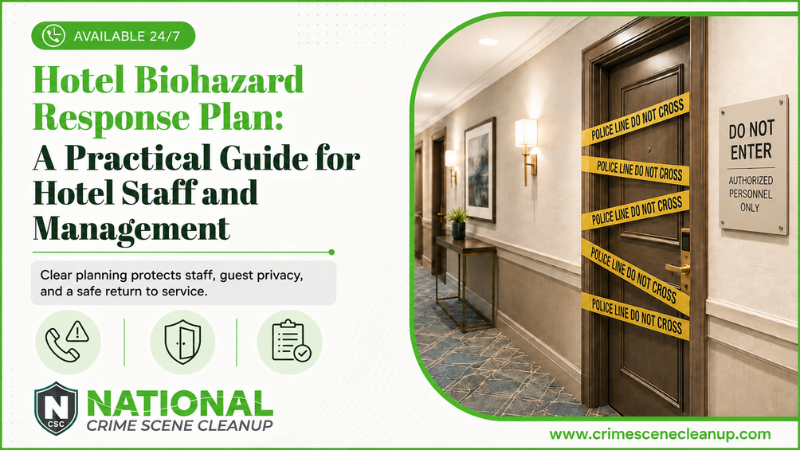
A hotel biohazard incident can affect employee safety, guest privacy, and room availability within minutes. Without a clear response plan, staff may not know whether to call emergency services, close an area, or wait for trained professionals.
A hotel biohazard response plan removes that uncertainty. It defines how your team responds from the initial discovery through professional remediation, documentation, and the room’s eventual return to service.
Preparation also helps your property meet workplace safety responsibilities while handling sensitive incidents discreetly. When contamination requires trained remediation, professional biohazard cleaning services can assess the affected area and restore it without placing hotel employees at further risk.
What Is a Hotel Biohazard Response Plan?
A hotel biohazard response plan is a written procedure for managing biological contamination in guest rooms, public spaces, and employee areas. It assigns responsibilities before an emergency happens so individual employees don’t have to make safety decisions under pressure.
An effective plan defines:
- Which incidents activate the response
- Who employees contact first
- How staff restrict access
- When to call 911 or law enforcement
- When professional remediation is required
- How employees report accidental exposure
- What information management records
- Who authorizes reopening
Adapt the procedure to your property’s staffing and layout. A large resort with on-site security needs a different contact chain than a small hotel with one overnight manager.
Which Hotel Incidents Require a Biohazard Response?
A hotel should activate its biohazard response plan when an incident involves blood, potentially infectious bodily fluids, contaminated sharps, human remains, or an unknown biological substance. Contamination involving porous materials also requires careful attention because the affected area may extend below the visible surface.
| Incident | Common hotel example | Immediate staff response |
|---|---|---|
| Blood or bodily fluids | Injury, assault, or medical emergency | Keep people away and notify management |
| Contaminated sharps | Needle in a room, trash bin, or hallway | Do not touch it and restrict access |
| Death or traumatic event | Suicide, homicide, or unattended death | Call authorities and preserve the area |
| Unknown contamination | Fluids affecting carpet, bedding, or furniture | Close the area and request professional help |
Hotels may maintain separate procedures for routine illness incidents, such as vomit without visible blood. Those procedures should still identify who is trained and authorized to respond.
Five Steps for Responding to a Hotel Biohazard Emergency
Hotel employees should focus on immediate safety and communication, not cleanup. A simple response sequence gives every shift the same instructions.
1. Call for Emergency Assistance
Call 911 when someone is seriously ill, injured, unresponsive, or deceased. Employees should provide aid only within the limits of their training and without making contact with biological material.
Do not move a deceased person or disturb nearby objects. If the event may involve a crime, wait for law enforcement to examine and release the scene.
2. Restrict Access
Close an affected guest room or establish a boundary around an incident in a public area. Keep guests and unnecessary employees away without entering the contaminated space.
A closed door may secure one room. A hallway, lobby, or elevator incident may require barriers and a temporary alternate route.
Use neutral language such as “Area Temporarily Closed.” This controls access without revealing private information or attracting unnecessary attention.
3. Notify the Designated Contacts
Employees should report the incident to the manager on duty and hotel security. Management can then activate the appropriate emergency contacts.
The hotel’s contact order should include:
- Emergency services or law enforcement, when required
- Manager on duty
- Security or corporate risk management
- Professional biohazard remediation provider
- Insurance or claims contact
- Local health department, when required
Keep current phone numbers where every shift can access them. Include after-hours contacts because serious incidents may occur when senior management isn’t on the property.
4. Report What Was Observed
Employees should describe what they saw from a safe location. They shouldn’t return to inspect the scene or attempt to determine how far contamination traveled.
Management initially needs to know:
- When and where the incident was discovered
- Whether someone is injured, ill, unresponsive, or deceased
- Whether blood, bodily fluids, sharps, or human remains are visible
- Whether anyone entered or touched the area
- Which emergency authorities were contacted
Staff should not lift bedding, move furniture, open bags, or examine carpet. These actions can expose hidden sharps, transfer contamination, or interfere with an investigation.
5. Contact Professional Remediation
Hotel employees should defer cleanup involving blood, sharps, death, trauma, decomposition, or possible hidden contamination. The area should remain restricted until authorities release it and trained professionals can evaluate it.
Professional remediation is needed when:
- A death occurred
- Blood or bodily fluids reached carpet, bedding, or upholstery
- Fluids may have entered floors, walls, or furniture
- Sharps are present
- Decomposition or persistent odor is present
- The incident may be connected to a crime
- Staff cannot identify the material
- The hotel cannot safely manage the resulting waste
Professional cleanup helps prevent contamination from spreading and reduces the risk of an incomplete response forcing another closure. The broader operational value is explained in how biohazard cleanup protects businesses.
Why the Visible Area May Not Show the Full Problem
A visible stain doesn’t always reveal the extent of biological contamination. Blood and decomposition fluids can penetrate carpet, padding, flooring seams, baseboards, and upholstered furniture.
Hotel staff should not search for hidden contamination themselves. A professional assessment determines which materials were affected, what can be restored, and what requires removal.
A death also doesn’t mean an entire floor automatically requires remediation. The cleanup scope should follow the actual contamination, as explained in our resource on determining the affected area after a death.
Odor may travel farther than biological material. Professionals must locate and address its source rather than assume every room where the odor is noticeable requires the same treatment.
Preventing Contamination From Spreading
Restricting access also means leaving potentially affected objects in place. Items moved out of the room can transfer biological material to laundry areas, hallways, elevators, and housekeeping equipment.
Until professionals assess the scene, hotel staff should not:
- Carry affected bedding to the laundry
- Roll housekeeping carts through the area
- Use a shared vacuum, mop, or carpet machine
- Remove trash or personal belongings
- Move furniture to inspect underlying surfaces
- Enter adjoining areas through the affected room
Management shouldn’t close an entire floor automatically. Restrict the immediate area first, then let emergency authorities or remediation professionals determine whether the boundary should expand.
OSHA Responsibilities for Hotel Management
Hotel employers must evaluate which job duties involve reasonably anticipated contact with blood or other potentially infectious materials. Job titles alone don’t determine whether occupational exposure exists.
OSHA explains that hotel housekeepers aren’t automatically considered occupationally exposed. However, employers must assess whether duties such as stripping beds or handling laundry can involve anticipated contact with blood or other potentially infectious material, according to OSHA’s hotel and motel industry interpretation.
Hotels may designate trained employees for specific approved tasks while instructing other employees to stop and report hazardous conditions. General housekeeping experience doesn’t qualify an employee to remediate a death scene or extensive biological contamination.
What Should Hotel Exposure Procedures Cover?
When OSHA’s Bloodborne Pathogens Standard applies, employer responsibilities may include an exposure control plan, training, safer work practices, PPE, and post-exposure procedures. The current OSHA Bloodborne Pathogens Standard requires employers to provide appropriate PPE at no cost when occupational exposure exists.
Hotel management should define:
- Which tasks may involve occupational exposure
- Which employees require specialized training
- Which incidents staff must defer
- How employees report accidental contact
- Where employees receive prompt medical evaluation
- How the hotel protects confidential exposure records
State occupational safety and waste requirements may exceed federal rules. Multi-state hotel operators should review each property instead of assuming one corporate procedure satisfies every jurisdiction.
What Should an Employee Do After Accidental Exposure?
An employee should stop work and report any splash, puncture, cut, or direct contact immediately. The hotel’s written procedure should direct the employee to prompt medical evaluation.
Immediate steps include:
- Wash exposed skin with soap and water.
- Flush exposed eyes, nose, or mouth with water.
- Notify the designated manager.
- Follow the hotel’s medical evaluation procedure.
- Document how and where the exposure happened.
The hotel should keep medical and exposure information confidential. Management should also review whether unclear assignments, missing training, or unauthorized entry contributed to the incident.
Preparing Staff Before an Incident
A hotel biohazard response plan must work during every shift. Housekeepers, managers, maintenance staff, security teams, overnight employees, and temporary workers all need clear instructions.
Training should focus on actions employees can perform safely:
- Recognizing a possible biohazard
- Calling emergency services
- Restricting access without approaching the material
- Notifying management and security
- Leaving potentially affected items in place
- Reporting accidental exposure immediately
Employees don’t need to diagnose the substance or estimate the cleanup area. Those decisions belong to emergency authorities and remediation professionals.
Keep the Plan Accessible
Place response instructions and current phone numbers at the front desk, security office, and housekeeping office. Digital copies should also remain accessible without requiring a senior manager’s login.
The hotel should maintain basic access-control supplies, such as closure signs and barriers. Specialized remediation equipment doesn’t replace professional training and shouldn’t encourage unqualified employees to begin cleanup.
What Happens During Professional Hotel Biohazard Remediation?
Professional remediation begins after emergency authorities release the property. Trained technicians determine the affected area, establish safe work zones, and prevent contaminated materials from reaching clean spaces.
Depending on the incident, the process may include:
- Establishing a controlled work area
- Identifying visible and hidden contamination
- Removing materials that cannot be safely restored
- Cleaning and treating salvageable surfaces
- Addressing the source of persistent odor
- Packaging and transporting regulated waste
- Documenting the completed work
Professional methods follow applicable requirements for containment, PPE, disinfection, material removal, and waste handling. Our guide to biohazard cleanup standards explains why these controls go beyond ordinary housekeeping.
Disinfectants must also match the organism and surface being treated. Professionals follow product-specific directions from EPA’s registered antimicrobial products, including application and contact-time requirements.
Protecting Guest Privacy During Cleanup
Hotel biohazard response requires discretion as well as physical safety. Guests don’t need to know why a room, hallway, or service area has temporarily closed.
Staff should not photograph a scene on personal phones, reveal a guest’s identity, or speculate about what happened. Assign one manager to handle internal updates and outside questions.
NCSC arrives in discreet vehicles that don’t clearly announce the presence of a biohazard cleanup team. This helps hotels avoid unnecessary attention from guests and bystanders while technicians enter the property and complete their work.
Management can also coordinate a service entrance, freight elevator, or low-traffic access route when the property layout allows. These arrangements protect privacy without changing the safety requirements of the remediation.
Documentation and Room Reopening
Keep one incident record from the initial report through the final reopening decision. A complete file supports internal review, insurance communication, and consistent management decisions.
What Should the Incident Record Include?
The record may contain:
- Date, time, and affected location
- Names of employees who reported or responded
- Emergency service or law enforcement information
- Employee exposure reports
- Remediation scope and waste records
- Completion documents
- Final reopening authorization
Limit access to employees with a legitimate operational, legal, or safety need. Keep medical information and identifying guest details out of general shift notes.
When Can a Hotel Room Reopen?
A room can reopen after authorities release the scene, professional remediation is complete, and the authorized manager reviews the supporting records. Appearance or odor alone isn’t enough.
Before returning the room to inventory, confirm:
- Authorities released the property
- Professionals assessed the affected area
- Contaminated materials were restored or removed
- Regulated waste was handled properly
- The source of any persistent odor was addressed
- Completion documentation was received
- The designated manager approved reopening
Keep the approval with the incident file. This documents the transition from emergency response to normal hotel use.
Hotel Biohazard Response Plan: Key Takeaways
A clear response plan gives every employee a safe, defined role during a difficult incident. The most important points include:
- Hotel staff should call for help, restrict access, and leave biological material undisturbed.
- Management should maintain current emergency contacts and clear reporting procedures for every shift.
- Blood, sharps, death scenes, porous contamination, and unknown substances require professional evaluation.
- OSHA responsibilities depend on the job duties and exposure risks present at the property.
- Incident records should cover the initial report, professional remediation, and final reopening decision.
- Guest privacy should remain protected through controlled communication, low-traffic access, and discreet cleanup vehicles.
- A room should return to service only after authorities release it, remediation is complete, and management reviews the supporting records.
National Crime Scene Cleanup provides discreet biohazard response for hotels, motels, and resorts across the United States. If your property is facing blood contamination, an unattended death, a traumatic incident, or another serious biohazard, reach out to our team for immediate assistance.
Frequently Asked Questions
How do you handle an emergency situation in a hotel?
Call 911 when someone is injured, unresponsive, or in immediate danger. Restrict access without entering the contaminated area, notify management, and contact professional remediation when a biohazard is present.
What should a hotel biohazard response plan include?
The plan should define staff responsibilities, emergency contacts, access restrictions, exposure reporting, professional cleanup requirements, documentation, and reopening authority. Instructions should remain accessible during every shift.
Can hotel housekeeping clean blood from a guest room?
Housekeepers shouldn’t clean blood unless the hotel has evaluated the task and provided the training, controls, and protection required by applicable rules. Death scenes, porous contamination, sharps, and extensive blood loss require professional remediation.
How can a hotel protect guest privacy during biohazard cleanup?
Hotels can restrict information, use neutral closure signs, and coordinate low-traffic access routes. NCSC also uses discreet vehicles that don’t visibly identify the responding team as a biohazard cleanup crew.
How does a hotel know when a contaminated room is safe to reopen?
The room can reopen after authorities release it, remediation is complete, and management receives the supporting records. The designated manager should approve its return to service rather than relying on appearance or odor alone.
