How Do ATP Testing Procedures Actually Work?
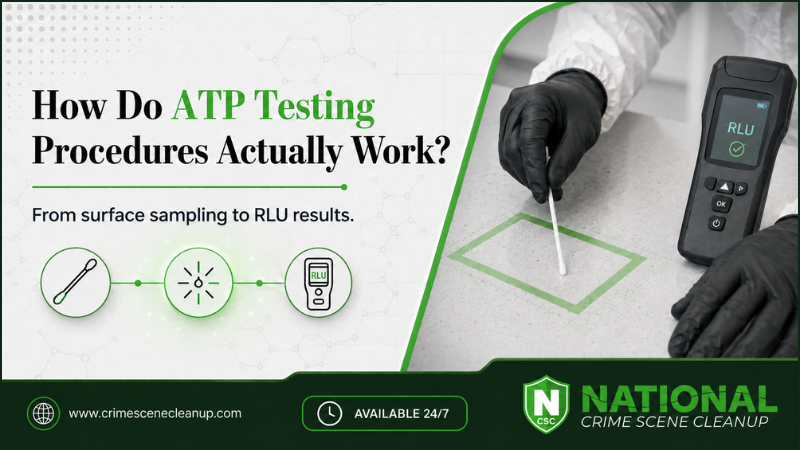
ATP testing procedures work by collecting a surface sample, activating a light-producing chemical reaction, and measuring that light with a luminometer. The resulting RLU reading helps technicians determine whether a sampled area meets the established cleaning criteria or requires additional work.
National Crime Scene Cleanup uses cleaning-verification methods when appropriate across our multiple cleaning services for homes, vehicles, businesses, and other properties.
Although the instrument produces a reading within seconds, the number alone does not verify a cleanup. Reliable results depend on representative test locations, consistent swabbing, system-specific acceptance limits, corrective cleaning, and clear documentation.
How Does the ATP Testing Method Work?
ATP testing detects adenosine triphosphate, an energy-carrying molecule found in living and once-living material. ATP on a cleaned surface can indicate that organic residue remains.
The testing method follows a short chemical and mechanical sequence:
- A specialized swab collects material from a surface.
- The collected ATP reacts with luciferin and luciferase inside the test.
- The reaction produces a small amount of light.
- A luminometer measures the light.
- The device reports the result in Relative Light Units, or RLUs.
- A technician compares the reading with the established acceptance criteria.
More light generally produces a higher RLU reading, which indicates that the swab collected more ATP. A lower reading indicates less detectable organic residue at that test point.
ATP testing has a specific role in remediation. Understanding what ATP testing measures in biohazard cleanup helps clarify why the procedure verifies cleaning but does not identify a particular contaminant.
How Do ATP Testing Kits Work in Crime Scene Cleanup?
An ATP testing kit contains the equipment needed to collect, activate, and measure a surface sample. Its swabs and luminometer must work as one compatible system because manufacturers can use different test chemistries and measurement scales.
A typical ATP testing kit includes:
- A sterile surface-sampling swab
- A sealed tube containing the test reagent
- A mechanism that releases the reagent
- A compatible handheld luminometer
- A method for recording test locations and readings
The swab collects the sample and exposes it to the test chemicals. Unlike a standard cotton swab, an ATP swab has collection and activation components designed for its corresponding testing system.
How Does an ATP Luminometer Function?
A luminometer measures the faint light created when ATP reacts with the test chemicals. It then converts the light intensity into an RLU reading.
The device does not directly count bacteria, measure toxicity, or identify the source of the ATP. For example, 200 RLU does not mean that a surface contains 200 bacteria or a specific amount of blood.
RLU readings only have meaning within the testing system and acceptance criteria used. Results from different luminometers should not be treated as interchangeable.
ATP Testing Procedures After Crime Scene Remediation
A reliable ATP test follows a planned sequence from site selection through documentation. Each step controls variables that could otherwise make a reading difficult to interpret.
1. Select Representative Testing Locations
Technicians select test points based on where biological material was present, where it could have spread, and which surfaces remain after remediation. Because one swab only represents one sampled area, choosing relevant locations matters more than collecting samples at random.
Representative test points may include:
- Surfaces that had visible biological contamination
- Edges around the original affected area
- Seams, joints, grout, and textured materials
- Frequently touched fixtures near the scene
- Cleaned materials that will remain in the property
- Areas exposed to cleanup tools or equipment
Testing every square inch is rarely practical. A focused sampling plan gives technicians more useful information than a larger number of samples taken only from easy-to-reach surfaces.
2. Complete Cleaning Before Verification
Technicians remove visible contamination and clean the affected surface before performing the verification test. ATP testing evaluates the result of that work but does not replace physical cleaning or disinfection.
Removing organic material before disinfection improves the treatment’s effectiveness, according to the Centers for Disease Control and Prevention.
Potential exposure does not automatically end when visible material disappears. The scene conditions and identified hazards determine which of the four levels of PPE technicians need while cleaning and handling test surfaces.
3. Swab a Defined Surface Area
The technician chooses a consistent sampling area and removes the swab without touching its tip. Contact with hands, clothing, or an unrelated surface could introduce ATP and affect the result.
A controlled swabbing method generally includes:
- Applying consistent pressure
- Covering the full defined area
- Using overlapping horizontal and vertical passes
- Rotating the swab during collection
- Following the contours of irregular surfaces
- Avoiding contact outside the selected test point
The sampled area must remain reasonably consistent between tests. A larger area has more opportunities to contribute ATP, so comparing substantially different sample sizes can produce misleading conclusions.
Surface shape also affects the collection method. A flat counter may allow a measured square, while a handle, seam, or narrow joint requires a pattern that follows the object.
4. Activate and Read the ATP Sample
After collecting the sample, the technician returns the swab to its tube and releases the reagent. The kit may use a snapping, pressing, or twisting mechanism.
The technician mixes the sample according to the manufacturer’s directions and inserts it into the compatible luminometer within the required period. The device then reports the light measurement as an RLU reading.
ATP swabbing verifies cleaning after a surface has been cleaned and visually inspected, a sequence also recognized in FDA cleaning-verification guidance.
5. Interpret the RLU Reading
The technician compares the RLU result with the acceptance criteria established for the specific testing system and remediation protocol. Depending on the system, the result may fall into a pass, caution, or fail category.
There is no universal RLU value that proves every type of surface is clean. Reliable interpretation depends on:
- The swab and luminometer system
- The manufacturer’s instructions
- The established acceptance limit
- The sampled area’s size
- The surface material and condition
- The location’s risk and intended use
- The cleaning products used before testing
A statement such as “every result below 100 RLU is safe” leaves out this context. A number considered acceptable under one protocol may not apply to another instrument or surface.
6. Respond to and Document the Result
A passing result supports that the sampled location meets the established criteria. A failed result calls for corrective cleaning followed by a new test of the same defined area.
Repeated failures may indicate:
- Residue trapped in a seam or joint
- Incomplete cleaning coverage
- Cross-contamination from equipment
- A damaged or difficult-to-clean surface
- Interference from testing conditions
A porous or damaged material that cannot be adequately cleaned may require removal. The appropriate response depends on the material and conditions found during remediation.
The final record should connect every result to its location and any action taken. Useful documentation may include:
- The property or project identification
- The date and time of testing
- The technician completing the test
- The exact room and surface location
- The ATP testing system used
- The applicable acceptance criterion
- The initial RLU reading
- Corrective cleaning performed
- The final retest result
A list of RLU numbers without locations or acceptance criteria provides little useful information. Complete records show how technicians reached the final status for each sampled surface.
What Do ATP Test Results Actually Prove?
ATP testing shows whether a sampled location contains detectable ATP under the conditions of that test. It provides rapid evidence of surface cleanliness, but it does not identify the material or organism that produced the ATP.
ATP monitoring cannot distinguish living bacteria from other organic material, according to Cornell University’s 2024 ATP monitoring fact sheet.
Each verification method answers a different question:
| Verification method | What it evaluates | Main limitation |
|---|---|---|
| Visual inspection | Visible residue and surface condition | Cannot detect microscopic residue |
| ATP testing | General organic residue at a test point | Cannot identify a specific pathogen |
| Microbial testing | Selected microorganisms in a sample | Requires separate analysis |
| Inspection with ATP testing | Visible and measurable cleaning results | Depends on representative sampling |
An ATP result can show whether cleaning reduced organic residue at the sampled location. It cannot prove that an entire room is sterile or free from every pathogen.
Is ATP Testing Accurate?
ATP testing provides dependable cleaning-verification data when technicians use consistent equipment, sampling areas, timing, and acceptance criteria. Uncontrolled differences between tests can change how much ATP the swab collects or how the system reads it.
A structured sampling plan improves the value of the results because convenient test points may not represent the wider environment, as research on ATP surface-sampling algorithms has found.
Factors that can affect ATP readings include:
- Uneven pressure or incomplete swab coverage
- Different sample-area sizes
- Moisture or residue on the surface
- Rough, absorbent, or damaged materials
- Accidental contamination of the swab
- Delayed measurement after activation
- Incompatible swabs and luminometers
- Residue from certain cleaning products
Technicians control these variables by following one documented procedure and the equipment manufacturer’s directions. They also interpret the reading alongside the surface condition rather than treating the RLU as an absolute measurement.
How Long Does ATP Testing Take?
A luminometer generally provides an RLU reading within seconds. Selecting the test point, collecting and activating the sample, and documenting the result add to the full procedure time.
The total time depends on the number of surfaces tested and whether any locations fail. A failed area must undergo corrective cleaning and retesting before technicians can assign its final status.
Frequently Asked Questions About ATP Testing Procedures
How does ATP testing work?
A swab collects material from a surface and exposes it to a light-producing chemical reaction. A luminometer measures the light and reports an RLU reading that technicians use to evaluate cleaning.
What does a high RLU result mean?
A high result indicates that the swab collected more ATP than the applicable acceptance limit allows. The location requires evaluation and usually needs additional cleaning and retesting.
Does ATP testing detect blood or specific pathogens?
No. ATP testing detects ATP as a general indicator of organic residue. It does not identify blood, bacteria, or a specific virus.
Is ATP testing accurate?
ATP testing produces useful results when technicians control the equipment, surface area, sampling method, timing, and interpretation criteria. It does not prove sterility or replace pathogen-specific analysis.
How long does an ATP test take?
The instrument reading takes seconds. The entire procedure takes longer because it includes sampling, documentation, and any corrective cleaning or retesting.
Key Takeaways About ATP Testing Procedures
ATP testing turns surface-cleaning verification into a measurable process. The main points to remember include:
- A swab collects ATP from a defined surface area.
- A luminometer reports the detected ATP as an RLU reading.
- RLU limits depend on the specific testing system and protocol.
- ATP testing indicates organic residue but does not identify pathogens.
- Failed locations require corrective cleaning and retesting.
- Consistent sampling and documentation make results more reliable.
If you need professional assistance after a crime, death, accident, or another biohazard event, reach out to us. National Crime Scene Cleanup can assess your property and determine which remediation and verification procedures the situation requires.
