Blood Clean Up Procedures: From Assessment to Final Clearance
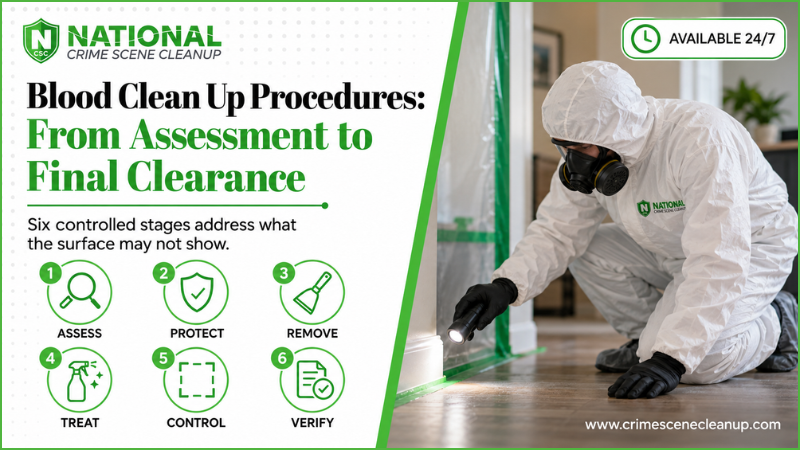
Blood can disappear from view while remaining beneath flooring, inside carpet padding, or within the seams of furniture. Removing the visible stain does not always address the full affected area.
Professional blood clean up procedures account for how blood moves through different materials. National Crime Scene Cleanup follows a controlled process that begins with assessment and ends with a final review.
If you need immediate help after a blood-related incident, our professional blood cleanup service addresses contamination in homes, vehicles, workplaces, and other affected properties.
What Are the Proper Blood Clean Up Procedures?
Proper blood clean up procedures involve assessing the contamination, controlling the work area, removing affected materials, cleaning and disinfecting restorable surfaces, managing waste, and verifying the completed work.
The response must match the amount of blood and the materials involved. A spill on sealed tile differs from blood that has entered carpet padding, drywall, or unfinished wood.
A professional cleanup follows six main stages:
- Assess the contamination and establish containment.
- Put on appropriate PPE and remove immediate hazards.
- Remove visible blood and determine which materials can be restored.
- Clean and disinfect restorable surfaces.
- Control waste, equipment, and cross-contamination.
- Inspect the area and complete final clearance.
Step 1: Assess the Contamination and Establish Containment
The first step defines where the contamination begins and ends. Technicians examine the visible area, surrounding materials, and any surfaces that people or objects may have touched.
A blood contamination assessment considers:
- The amount and condition of the blood
- How much time has passed
- The surface beneath the visible stain
- Nearby furniture and personal items
- Doors, switches, handles, and walking paths
- Needles, broken glass, or other hazards
- Previous attempts to clean the area
Blood may travel beneath baseboards, through flooring seams, or into absorbent layers. The assessment identifies these possible pathways before removal or cleaning begins.
Next, technicians establish a controlled work area. Containment restricts access and separates affected materials from clean supplies and occupied spaces.
| Work area | Purpose | Typical activity |
|---|---|---|
| Clean area | Protects unused supplies | Equipment and PPE preparation |
| Transition area | Controls entry and exit | Equipment checks and PPE removal |
| Contaminated area | Contains affected materials | Removal, cleaning, and disinfection |
The setup depends on the size and location of the scene. A contained room may need one controlled entrance, while a larger area may require added barriers and a planned waste-removal route.
Step 2: Put On PPE and Remove Immediate Hazards
PPE must match the exposure risks found during the assessment. The goal is to protect the skin, eyes, clothing, and other possible entry points while technicians work.
Depending on the scene, PPE may include:
- Disposable gloves suited to the task
- Eye or face protection
- Protective clothing
- Shoe or boot coverings
- Cut-resistant protection
- Respiratory protection when required by the assessment
Technicians inspect protective equipment during the work and replace damaged or heavily contaminated items. PPE remains on until they reach the designated removal area.
Sharps and physical hazards require attention before technicians handle absorbent materials. Needles, broken glass, or exposed metal can puncture gloves and create a direct exposure route.
Technicians use mechanical tools to collect suspected sharps instead of picking them up by hand. They place each object into an appropriate puncture-resistant container.
Step 3: Remove Blood and Evaluate Affected Materials
Visible blood must be removed before technicians can properly clean and disinfect a surface. Absorbent materials help collect free liquid without spreading it beyond the established boundary.
After removing surface blood, technicians determine whether each affected material can be restored. Porosity and contamination depth guide that decision.
| Material | How blood behaves | Typical response |
|---|---|---|
| Sealed tile or metal | Remains mostly on the surface | Clean and disinfect if intact |
| Carpet and padding | Passes through the visible fibers | Evaluate each affected layer |
| Drywall or insulation | Absorbs into the material | Remove contaminated portions |
| Upholstery or mattresses | Reaches seams and inner layers | Remove when full treatment is not possible |
| Unfinished wood or subfloor | Enters pores, gaps, and joints | Assess depth before treatment or removal |
A surface-level cleaning cannot reach blood inside carpet padding or wall material. Technicians may need to remove an affected layer to reach the contamination beneath it.
This limitation accounts for many of the risks of DIY blood cleanup. Household equipment may improve the appearance of a surface without reaching absorbed blood.
Removal should stay limited to materials that cannot be properly cleaned and disinfected. This approach exposes the affected area while preserving materials that remain suitable for restoration.
Step 4: Clean and Disinfect Restorable Surfaces
Cleaning and disinfection perform different jobs. Cleaning removes blood and debris, while disinfection addresses specified microorganisms on a compatible surface.
| Term | What happens | Purpose |
|---|---|---|
| Cleaning | Blood, soil, and debris are removed | Prepares the surface for treatment |
| Disinfecting | A registered product stays on the surface as directed | Addresses microorganisms covered by its label |
| Decontaminating | Contamination is removed or neutralized | Makes the area safer to handle or use |
The order matters because remaining blood can interfere with some disinfectants. Current CDC procedures for blood and body fluid spills direct personnel to contain and remove the spill, clean the surface, and then apply an appropriate disinfectant.
Technicians use fresh cleaning materials as they move through the work area. Reusing a contaminated cloth or returning it to a clean solution can transfer biological material to another surface.
Choosing and Applying a Disinfectant
The disinfectant must match the pathogen claim and surface involved. Technicians also follow the label for dilution, application method, and contact time.
The EPA maintains a list of registered products effective against bloodborne pathogens. Product claims may cover HIV, hepatitis B virus, hepatitis C virus, or a combination of those pathogens.
Contact time refers to how long the surface must remain visibly wet. The required time varies, so spraying a product and immediately wiping it away may not complete the disinfection process.
Technicians also check surface compatibility. A product registered for hard, nonporous materials may not provide the same result on unfinished wood, carpet, or upholstery.
Is Bleach Appropriate for Blood Cleanup?
Bleach can disinfect some compatible surfaces, but one mixture does not suit every spill. Its concentration, preparation, contact time, and label directions determine proper use.
Bleach may discolor textiles or damage certain finishes. It must never be mixed with ammonia, acids, or other cleaners because the combination can release dangerous gas.
Step 5: Control Cross-Contamination, Waste, and Equipment
Cross-contamination occurs when blood moves from the original scene to an unaffected surface. Shoes, gloves, tools, or waste containers can create that transfer during cleanup.
Understanding how bloodborne pathogens are spread explains why technicians inspect more than the primary stain. Exposure can occur when contaminated blood reaches broken skin, a puncture wound, or the eyes, nose, or mouth.
Likely transfer points include:
- Door handles and cabinet pulls
- Light switches
- Phones and control panels
- Tool handles
- Reusable containers
- Hallways used to move waste
- Vehicle doors and cargo areas
Technicians package contaminated materials before moving them outside the controlled area. Soft waste requires suitable leak-resistant containment, while sharps need rigid, puncture-resistant containers.
Waste requirements can vary by state and locality. The correct method may also depend on the type, amount, and condition of the material.
Reusable equipment stays within the work process until it has been cleaned and decontaminated. Disposable supplies enter the appropriate waste stream.
Technicians remove PPE in the transition area without allowing the contaminated exterior to touch exposed skin or clean clothing. Hand hygiene follows immediately after removal.
Step 6: Complete the Final Clearance Process
Final clearance confirms that technicians completed the defined cleanup scope. The review covers the original contamination area and any secondary surfaces identified during the assessment.
The final inspection includes:
- Checking the original contamination boundary
- Confirming the removal of visible biological material
- Inspecting seams, edges, and exposed structural areas
- Verifying that material removal reached the affected depth
- Reviewing disinfectant application and contact time
- Confirming that waste has been contained
- Documenting the completed work
If the inspection identifies untreated material, technicians return to the required cleanup stage. Final clearance comes after they correct the remaining issue.
Final clearance does not mean every scene receives a universal laboratory certificate. The verification method depends on the incident, work performed, property requirements, and applicable regulations.
What Is the OSHA Protocol for Cleaning Up Blood?
OSHA requires employers to control occupational exposure when employees may encounter blood or other potentially infectious materials. Its requirements cover universal precautions, PPE, housekeeping, sharps, regulated waste, training, and exposure response.
Under the OSHA Bloodborne Pathogens Standard, employers must decontaminate affected work surfaces after contact with blood or other potentially infectious materials. Employers must also use suitable containers and handling procedures for regulated waste.
The standard does not provide one household cleaning formula for every spill. It requires employers to select controls and procedures that match the occupational exposure.
The reason OSHA bloodborne pathogens cleanup is critical comes down to exposure control. A prompt, structured response limits contact with contaminated surfaces and prevents an affected area from remaining in use.
When Are Home Blood Clean Up Procedures Unsafe?
Home cleanup becomes unsafe when you cannot identify the contamination boundary, protect everyone nearby, or reach the affected material. Large spills and blood beneath surface layers require more than ordinary stain removal.
Contact National Crime Scene Cleanup when:
- Blood has soaked through carpet or flooring.
- The incident involves upholstered furniture or a mattress.
- Blood has reached drywall, insulation, or unfinished wood.
- Needles, broken glass, or other sharps are present.
- Several surfaces or rooms may be affected.
- You cannot keep other people or pets away.
- An odor remains after the visible blood is gone.
- You do not know how long the blood has been present.
- The emotional impact makes direct cleanup difficult.
Until help arrives, keep people away and avoid moving affected items. Do not vacuum, sweep, scrub, or direct fans across the area because those actions can move contaminated material.
Frequently Asked Questions
What is the proper procedure for cleaning up a blood spill?
The proper procedure is to assess and contain the spill, wear suitable PPE, remove sharps, collect visible blood, and evaluate the affected materials. Restorable surfaces must then be cleaned, disinfected for the required contact time, and inspected.
Can a regular household cleaner disinfect blood?
A general cleaner may remove visible blood without disinfecting the surface against bloodborne pathogens. Use an EPA-registered disinfectant with an appropriate pathogen claim and follow its label.
How long should disinfectant remain on a blood spill?
Keep the surface wet for the full contact time listed on the disinfectant label. The required time varies by product and pathogen.
Is dried blood still treated as a biohazard?
Yes. Drying does not prove that blood is free from infectious hazards, so you should treat dried blood as potentially infectious and avoid direct contact.
Do OSHA blood clean up procedures apply inside a home?
OSHA’s Bloodborne Pathogens Standard applies to occupational exposure. It may cover employees working inside a residence, but it does not serve as a general household cleanup law for homeowners.
When should you call a professional blood cleanup company?
Contact National Crime Scene Cleanup when blood involves porous materials, sharps, a large area, or possibly spread to several surfaces. Professional help also makes sense when you cannot determine the full contamination boundary or manage the waste safely.
Blood Clean Up Procedures Continue Until Final Clearance
Professional blood clean up procedures address the full contaminated area rather than only the visible stain. Assessment, material removal, surface treatment, waste control, and final inspection all serve different parts of that process.
The main takeaways are:
- Assessment defines the complete work area.
- Containment protects unaffected spaces.
- Material porosity determines whether restoration is possible.
- Cleaning prepares a surface for disinfection.
- Disinfectant labels determine proper application.
- Waste and equipment require controlled handling.
- Final clearance confirms completion of the defined scope.
National Crime Scene Cleanup provides professional support for blood-related incidents across the United States. If blood has affected your home, workplace, vehicle, or other property, contact National Crime Scene Cleanup so our team can assess the situation and explain the next step.
