Biohazard Cleanup Requirements for Safe, Compliant Work
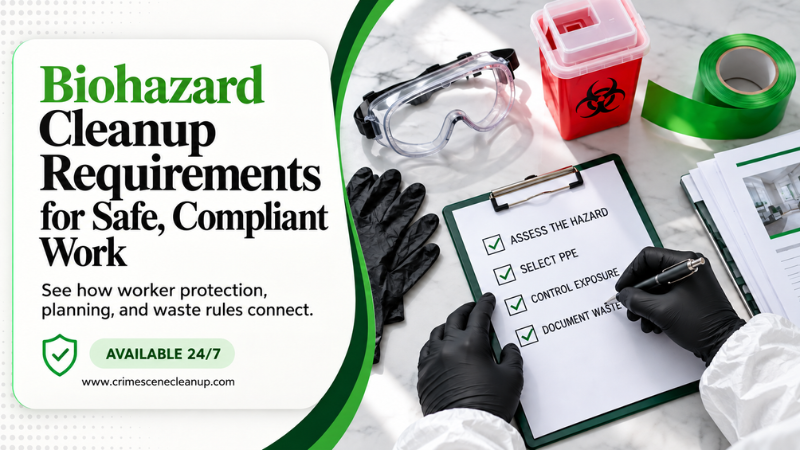
Removing visible blood or biological material does not make a cleanup safe or compliant. The work must also protect employees, control exposure, manage contaminated waste, and follow the regulations that apply where the incident occurred.
Biohazard cleanup requirements change with the hazard, property, work being performed, and location. National Crime Scene Cleanup provides professional biohazard cleanup for affected homes, vehicles, workplaces, and other properties across the United States.
What Are the Legal Requirements for Biohazard Cleanup?
No single federal regulation controls every part of biohazard cleanup. OSHA regulates occupational exposure, while state agencies oversee much of the storage, treatment, and disposal of regulated medical or infectious waste.
The main responsibilities divide into four areas:
| Compliance area | What it covers | Responsible party |
|---|---|---|
| Worker protection | Exposure controls, PPE, training, and medical support | Employer |
| Scene safety | Assessment, restricted access, and safe work practices | Employer and technicians |
| Waste management | Classification, containment, treatment, and disposal | Generator and disposal facility |
| Transportation | Packaging and movement of regulated medical waste | Shipper and transporter |
State and local agencies may also require permits, registrations, storage limits, or disposal records. The rules must be identified for the location where the waste originates.
Is a biohazard cleanup certification legally required?
The United States does not issue one federal certification that authorizes every type of biohazard cleanup. Private certifications can document education, but they do not replace OSHA compliance or licenses and permits required by a state or locality.
Safe work depends on the complete program behind the technician. That includes proper training, current safety plans, suitable equipment, exposure response, and a lawful waste route.
What Are the OSHA Regulations for Biohazard Cleanup?
OSHA’s Bloodborne Pathogens Standard applies when employees can reasonably expect contact with human blood or other potentially infectious materials while performing their jobs. It creates responsibilities for covered employers rather than a general licensing system for cleanup work.
The current Bloodborne Pathogens Standard in 29 CFR 1910.1030 addresses:
| OSHA requirement | Purpose |
|---|---|
| Exposure control plan | Identifies exposed positions, tasks, controls, and response procedures |
| Universal precautions | Treats human blood and specified bodily fluids as potentially infectious |
| Engineering and work practice controls | Reduces exposure through equipment and safer methods |
| Personal protective equipment | Protects against exposure that other controls cannot eliminate |
| Training and medical support | Prepares workers and establishes protection after an exposure |
| Housekeeping and waste controls | Governs decontamination and containment at the worksite |
| Recordkeeping | Documents training, medical information, and qualifying incidents |
These rules focus on occupational exposure. They do not apply to a private homeowner in the same way, although biological hazards and state waste requirements may still affect what the homeowner can safely or legally do.
Employers need a written exposure control plan
A covered employer must maintain a written plan designed to eliminate or reduce occupational exposure. It must identify affected job classifications and tasks, explain the controls employees will use, and establish procedures for responding to an exposure incident.
The employer must review the plan at least annually. New tasks, equipment, technology, or employee positions may require another update before the annual review.
The plan must remain accessible to affected employees. Field practices and training should reflect its contents rather than treating it as a document used only for recordkeeping.
Universal precautions guide blood cleanup
Universal precautions require workers to treat human blood and certain bodily fluids as if they contain infectious bloodborne pathogens. Appearance cannot show whether blood presents an infection risk.
This principle supports OSHA bloodborne pathogens cleanup because it explains why blood requires controlled handling even when a spill looks small or contained. The linked resource also examines how blood can enter porous materials and spread beyond the visible area.
Not every bodily fluid automatically meets OSHA’s definition of other potentially infectious material. However, visibly bloody fluids and situations where the fluid cannot be identified require appropriate precautions.
Exposure controls come before PPE
Employers must use engineering and work practice controls to eliminate or reduce exposure before relying on protective clothing. PPE adds protection where those controls cannot remove the remaining risk.
Common controls include:
- Puncture-resistant sharps containers
- Accessible handwashing facilities
- Mechanical tools for handling contaminated broken glass
- Methods that limit splashing or spraying
- Separation of clean and contaminated equipment
- Safe placement of waste containers
Gloves cannot prevent a puncture if someone reaches into a bag containing a needle. Using a mechanical pickup tool and placing the needle directly into a sharps container controls the hazard more effectively.
These requirements shape how crime scene cleaners follow biohazard cleanup procedures during containment, material removal, disinfection, waste handling, and verification. The procedures turn written requirements into controlled actions at the scene.
Biohazard Remediation Planning Determines What the Scene Requires
Scene assessment identifies the hazards, affected materials, exposure routes, and required work before cleanup begins. That information determines the controls, PPE, and waste-handling method needed for the job.
Effective biohazard remediation planning examines:
- The type and location of biological material
- Possible sharps, chemicals, and structural hazards
- Contamination beneath or beyond visible surfaces
- Potential contact, splash, puncture, or inhalation exposure
- Materials that can be treated and those that require removal
- Waste classifications that may apply
A blood spill on sealed tile does not require the same plan as decomposition fluid beneath flooring. The assessment connects broad safety requirements to the conditions technicians will encounter.
What PPE Is Required for Biohazard Cleanup?
Biohazard cleanup PPE must match the hazards and tasks identified during the assessment. No regulation assigns one fixed suit or respirator to every crime, trauma, or blood cleanup.
Depending on the scene, technicians may need:
- Task-appropriate gloves
- Disposable coveralls or protective clothing
- Eye and face protection
- Protective footwear
- Respiratory protection
The exposure route, splash potential, sharps risk, material, and planned task guide the selection. Fit and compatibility also matter because one piece of equipment cannot interfere with another.
Understanding how the 4 levels of ppe keep technicians protected provides more context about different combinations of respiratory and skin protection. Levels A through D offer a framework, but they do not prescribe one outfit for every biological hazard.
Respirator use requires more than selecting a mask
A respirator cannot be selected only because a scene has a strong odor or looks hazardous. The employer must identify the respiratory hazard and determine whether the equipment can protect against it.
A compliant respiratory protection program may require:
- Medical evaluations
- Fit testing
- Hazard-specific equipment selection
- Employee training
- Inspection, cleaning, and storage
Air-purifying respirators do not supply oxygen or protect against every gas, vapor, or particle. Unknown atmospheric conditions require further assessment before work continues.
What Training Do Biohazard Cleanup Workers Need?
Workers need training that matches the hazards and duties they may encounter. General cleaning experience does not replace bloodborne-pathogen training or instruction for specialized equipment and chemicals.
Covered employees must receive bloodborne-pathogen training when first assigned to duties involving occupational exposure. OSHA also requires annual training and additional instruction when new tasks or procedures create different risks.
Training may cover:
- Bloodborne-pathogen exposure
- The employer’s exposure control plan
- Engineering and work practice controls
- PPE use and removal
- Hazard communication
- Respiratory protection
- Sharps and waste handling
- Exposure reporting
Employees must receive the information in language and vocabulary they understand. Training must also provide an opportunity for questions.
Employers must prepare for exposure incidents
The exposure response process must explain what employees should do after a needlestick, cut, splash, or other qualifying contact. Preparing the response before an incident prevents delays.
Covered employers must make the hepatitis B vaccination series available to eligible employees at no cost. OSHA generally requires the offer after training and within 10 working days of initial assignment.
Following an exposure incident, the employer must promptly provide a confidential medical evaluation and follow-up. Medical and training records must follow OSHA’s access, retention, and confidentiality requirements.
What Are the Federal Guidelines for Biohazard Waste Disposal?
Federal rules control parts of waste containment and transportation, but states regulate most medical and infectious waste treatment and disposal. The correct route depends on the waste and where it originated.
The EPA’s medical waste guidance, updated in April 2026, explains that state environmental and health departments primarily regulate medical waste. State programs may use different definitions, storage limits, treatment requirements, and licensing systems.
Waste must be classified before packaging
Not every object removed from an affected room automatically becomes regulated waste. The material, its physical condition, and the applicable state definition determine how it must be handled.
OSHA defines regulated waste to include:
- Liquid or semi-liquid blood or other potentially infectious material
- Contaminated items that would release such material when compressed
- Items caked with dried material that could release it during handling
- Contaminated sharps
- Specified pathological and microbiological waste
Classification determines the container and disposal route. It also prevents unaffected property from being discarded without a reason.
Containers must match the material
Regulated-waste containers must close securely, contain their contents, resist leakage, and carry required labels or color coding. Sharps require puncture-resistant containers that remain upright and do not become overfilled.
If contamination reaches the outside of a primary container, secondary containment may be required. The second container must also prevent leakage during handling, storage, or transportation.
Transportation creates separate requirements
Once regulated medical waste enters transportation, additional federal and state rules may apply. The current 49 CFR 173.197 requirements for regulated medical waste address authorized packaging, leak control, sharps resistance, and other transportation conditions.
Before waste leaves the property, we determine:
- How the jurisdiction classifies the material
- Which packaging requirements apply
- Which transportation rules govern the load
- Where the waste can be accepted
- Which records must document its transfer or disposal
A red bag alone does not make waste ready for transportation. Its packaging and destination must match the waste classification.
What Can You Ask NCSC About Compliance?
You should understand how the applicable requirements affect your property without having to interpret federal and state regulations alone. Our team can explain the controls and waste route connected to your cleanup.
You can ask us:
- What hazards affect the scope of work?
- Which safety controls and PPE does the scene require?
- How will we classify and contain removed materials?
- How will the waste leave the property?
- What documentation applies to the completed work?
The answers depend on the contamination and the rules in your location. We apply those requirements to the actual scene instead of treating every job as identical.
Frequently Asked Questions
Is there a federal biohazard cleanup license?
No single federal license authorizes every type of biohazard cleanup in the United States. OSHA may regulate employee exposure, while state or local agencies may require permits, registrations, or licenses for specific waste activities.
Does OSHA certify biohazard cleanup companies?
OSHA establishes and enforces workplace safety standards. It does not issue one universal certification that proves compliance with every federal, state, and local requirement.
Can regular employees clean blood at work?
An employer cannot treat willingness as the only qualification. If the assigned work creates reasonably anticipated occupational exposure, the employer must determine whether OSHA’s Bloodborne Pathogens Standard applies and provide the required protections.
Who regulates biohazard waste disposal?
State environmental and health departments regulate most medical and infectious waste treatment and disposal. OSHA addresses workplace exposure and containment, while transportation authorities regulate qualifying waste in transit.
Safe Work Connects Every Biohazard Cleanup Requirement
Biohazard cleanup requirements cover more than the condition of a surface after cleaning. They begin with an accurate scene assessment, protect technicians through task-specific controls and training, and continue through waste classification, packaging, transportation, and disposal.
That full chain matters. A cleanup cannot meet its responsibilities if the visible contamination disappears but workers face preventable exposure or removed material enters the wrong waste route.
National Crime Scene Cleanup applies the requirements relevant to each scene and service location across the United States. If blood, bodily fluids, decomposition, sharps, or other biological hazards affect your property, contact National Crime Scene Cleanup for discreet help 24 hours a day.
