Blood Under Hardwood Floors: Can It Be Remediated?
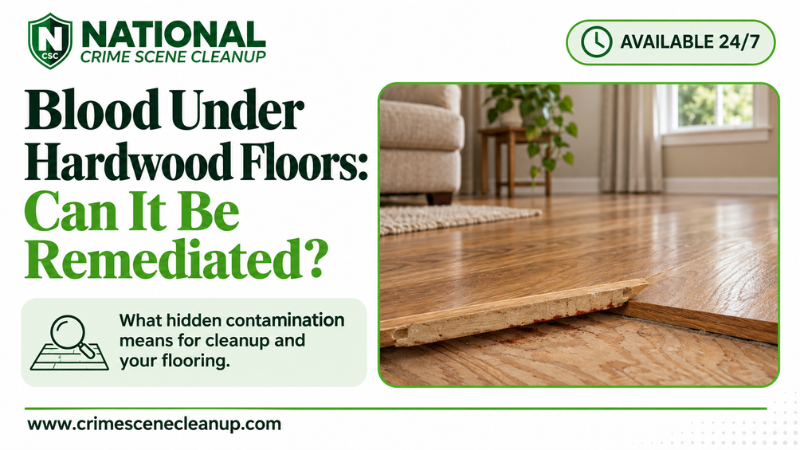
Blood under hardwood floors can be remediated, but saving the original boards depends on where contamination reached. We treat accessible materials when effective cleanup allows it and remove affected components that cannot support adequate treatment.
At National Crime Scene Cleanup, our professional blood cleanup addresses the flooring and any affected layers beneath it. The starting point is an assessment, not a decision to replace the entire room’s floor.
Can Blood Under Hardwood Floors Be Remediated Without Full Replacement?
Yes. Selective removal can give us access to hidden blood while preserving unaffected flooring. These findings guide the treatment decision:
| Assessment finding | What we need to establish | Likely response |
|---|---|---|
| Blood remains on an intact finished surface | Whether contamination stayed above the board joints | Clean and disinfect suitable surfaces |
| Residue reaches board edges or undersides | Whether we can access and adequately treat those components | Open the affected section for assessment |
| Blood penetrates absorbent material | Whether treatment can address the affected depth | Remove material that cannot support adequate treatment |
| Contamination reaches the subfloor | Which supporting components need attention | Treat suitable surfaces or remove affected sections |
How Does Blood Get Beneath Hardwood Flooring?
Blood enters the floor through joints or other openings, then reaches the materials underneath. A protective surface finish doesn’t establish that every board edge or connection prevents liquid entry.
Once blood reaches exposed wood, absorption can complicate the cleanup. The underside of a board may need attention even when its upper surface looks unaffected.
What affects how far blood spreads?
The amount of liquid and the available pathways determine which areas need inspection. We consider:
- Spill volume. Pooling supplies more liquid to an opening than isolated drops.
- Time before cleanup. Blood can continue entering accessible gaps while it remains fluid.
- Surface condition. Scratches or worn finishes expose absorbent wood.
- Floor openings. Gaps near transitions, pipes, or wall edges provide routes underneath.
- Earlier cleaning. Added water or movement through the spill can change the original pattern.
Can blood pass through carpet onto hardwood underneath?
Yes. Blood can pass through carpet backing and padding before reaching an older wood floor.
We assess carpet after blood contamination together with the underlying hardwood when your property has layered coverings. Removing the carpet doesn’t establish that the wood beneath it escaped contamination.
How Can You Tell Whether Blood Reached the Subfloor?
You cannot confirm a concealed subfloor’s condition from the finished surface alone. Our biohazard cleanup assessment identifies where the evidence supports further access beneath the boards.
We start with the incident information you already have. You don’t need to lift flooring or enter an affected room to gather more details before calling.
What findings justify checking beneath the boards?
Evidence that blood entered an opening can support a closer inspection. Relevant findings include:
- Known pooling across an open flooring joint.
- Residue beneath an exposed transition or board edge.
- Blood on the underside of flooring someone already removed.
- Previous cleanup that addressed the walking surface without examining the layers below.
Wood swells and shrinks with moisture changes, so warped boards alone don’t identify blood. We consider physical damage alongside the incident history rather than assume every discolored area needs biohazard removal.
Can testing identify an unexplained stain?
A screening result alone cannot confirm blood. A presumptive test indicates possible material presence, but a positive result does not establish identification.
That distinction matters when you discover an old mark during renovation without knowing its source. Our cleanup assessment also does not replace a forensic investigation or authorize access to a restricted scene.
What Health Risks Come From Old Blood Under Wood Floors?
Old blood needs cautious handling because appearance and age cannot establish whether infectious material remains. We treat suspected human blood as potentially infectious without assuming every old stain contains an active pathogen.
The exposure route matters because bloodborne pathogens can be spread when infected blood reaches broken skin or a puncture wound, or contacts the eyes or mouth.
Standing near a concealed stain does not establish that this type of exposure occurred. Removing contaminated flooring introduces handling risks that the intact walking surface may have concealed.
Why does floor removal require exposure controls?
Opening the floor can expose residue on hidden components. Splintered wood and sharp fasteners also affect how we handle removed materials.
Our approach to OSHA bloodborne pathogens cleanup includes protective equipment that matches the task and controls that reduce contact with contaminated material. Routine flooring work doesn’t automatically account for those biological exposure risks.
What Determines Whether the Hardwood Can Stay?
We base preservation on access to contamination and the material’s ability to support treatment. The floor’s construction helps us plan the work, but its price or appearance cannot establish whether it can remain.
Solid hardwood versus engineered hardwood
Solid hardwood consists of one piece of wood, while engineered hardwood includes multiple layers. These wood flooring types also differ in how much refinishing their construction allows.
For cleanup planning, we inspect the components that actually contacted blood. An exposed engineered core requires a different evaluation from residue confined to an intact finished face.
We also consider the board’s condition after access. A component may require replacement because removal damaged its connections, even when the contamination itself remained limited.
Does the installation method affect removal?
Yes. Adhesive or fasteners can make opening a floor more involved than lifting loose boards.
Connected planks may require access through a larger section to reach the affected area. We distinguish material removed for access from material removed because blood penetrated it.
Can we replace only the affected boards?
Yes, when selective removal gives us enough access to complete the remediation. We inspect each newly exposed layer before recommending a larger removal area.
For example, blood near a doorway may involve a transition and adjoining board edges. That finding calls for targeted inspection rather than an assumption that every board in the room needs replacement.
Later finish matching can expand the repair area. A larger cosmetic repair doesn’t necessarily mean biological contamination reached that entire space.
What Steps Do We Take to Remediate Blood Under Hardwood Floors?
Our blood cleanup procedures move from assessment through final review. Flooring access adds decisions about which concealed components need treatment or removal.
The work follows this sequence:
- Review the incident and define the scope. We inspect accessible conditions and record what the intact floor prevents us from confirming. The proposed work explains the access we need.
- Establish work boundaries. We select protective equipment for the tasks involved and plan how contained materials will leave the area. Shared hallways or occupied rooms affect that setup.
- Open the affected section. We inspect board undersides and the newly exposed supporting surface. Additional findings require an explanation of the proposed scope change before we expand the work.
- Remove unsuitable material and treat remaining surfaces. We remove biological residue before appropriate disinfection. The selected product must suit the surface and meet its relevant label directions.
- Contain and manage waste. We package removed components for controlled movement. Applicable biohazard cleanup requirements determine the waste classification and disposal responsibilities for your location.
- Review the completed work. We check the treated area against the approved scope and document remaining limitations. The handoff identifies any repairs that must follow remediation.
What determines which disinfectant we use?
The surface and intended use determine product selection. A method suitable for an intact sealed finish doesn’t automatically provide the same result on unfinished wood.
Our technicians follow the label’s required wet contact time. Spraying a surface and immediately wiping it dry may prevent the product from completing that requirement.
A cleaner also needs access to the contaminated surface. Applying a product above an intact floor cannot establish treatment of its concealed underside.
How Do We Safely Address Dried Blood on a Subfloor?
We evaluate whether the affected subfloor can support adequate cleaning and disinfection. When penetration prevents effective treatment, we remove the affected section within the agreed scope.
The supporting material matters because a wood panel and a concrete base present different access conditions.
Plywood and other wood based subfloors
Wood based panels can absorb liquid at exposed surfaces or joints. We assess the affected depth rather than assume that dried residue remains only on top.
Swelling or separating panel layers can introduce a repair need alongside contamination removal. Our recommendation distinguishes material damage from the biological findings.
A strong surface doesn’t prove that the panel avoided fluid contact. Likewise, a damaged panel doesn’t establish blood contamination without supporting information.
Hardwood installed over concrete
Concrete still needs assessment when blood reaches it. Its surface condition and cracks influence the treatment plan.
Adhesive or underlayment can obstruct access to the affected base. We evaluate those intervening layers before deciding how to address the concrete.
How deep does contaminated flooring need to be removed?
There is no fixed removal depth that fits every blood spill. We follow the findings until the remaining components support adequate treatment.
Blood in an upper layer doesn’t automatically establish contamination in the framing below. We recommend further access when the exposed conditions justify it.
Does Blood Stain Hardwood Permanently?
Blood can permanently discolor exposed wood, particularly when it penetrates beyond the finish. We evaluate that cosmetic damage separately from whether the affected material supports remediation.
A remaining mark doesn’t, by itself, prove ongoing infectious risk. Discoloration can also remain after appropriate treatment, so appearance alone cannot settle the cleanup decision.
What takes blood out of hardwood floors?
We use professional cleaning and appropriate disinfection for surfaces that support treatment. Blood absorbed beyond effective treatment can require removing the affected wood.
The product choice depends on the finish and the contamination involved. A household stain remover cannot establish that hidden layers received adequate treatment.
Will sanding remove deep blood contamination?
Sanding can alter the top surface, but it doesn’t resolve blood beneath board connections or on inaccessible undersides.
We assess hidden contamination before discussing refinishing. Any later sanding must also account for the remaining wood thickness and the floor’s construction.
For example, improving a board’s top surface would leave the original cleanup incomplete if contaminated underlayment remained beneath it.
Why Can Odor Remain After Surface Cleaning?
Odor can persist when biological residue remains beneath the floor or surrounding material retains the smell. We investigate the source before deciding whether additional treatment is necessary.
Addressing concealed residue helps remove odor caused by biohazards. Fragrance or a temporary improvement doesn’t document source removal.
Smell alone cannot identify blood or establish an infectious hazard. Persistent odor calls for reassessment rather than automatic removal of every nearby component.
What Happens Before Replacement Flooring Goes Down?
We complete the agreed contamination work before new flooring conceals the exposed area. The transition to repairs also needs clear documentation.
Your remediation handoff should identify:
- The components we treated or removed.
- Any unresolved access limitations.
- Supporting surfaces that need repair.
- Reconstruction tasks included in the agreement.
- Remaining conditions that affect normal use.
Completed remediation can leave a floor unfinished. We clarify whether the estimated completion date covers cleanup or includes the construction work needed afterward.
Drying and decontamination answer different questions. A dry surface doesn’t establish successful disinfection, and treated material may still need structural repair before new flooring installation.
What affects the cleanup cost and timeline?
The affected layers and difficulty of access determine the work involved. A small stain beneath fixed cabinetry can require more access labor than a larger accessible area.
Removed material also adds handling and disposal work. We base the estimate on those tasks and explain changes when opening the floor reveals additional contamination.
Key Takeaways About Blood Under Hardwood Floors
Blood under hardwood floors requires an assessment of the affected layers. The main points are:
- Full room replacement is not automatic.
- Access and material condition guide preservation decisions.
- Stain removal cannot establish treatment beneath the boards.
- Subfloor remediation and later construction can involve separate work.
- Contact our team at National Crime Scene Cleanup to discuss your property and arrange an assessment. Our representatives are available 24/7.
Frequently Asked Questions
Can blood beneath hardwood floors be remediated, or does the flooring need replacement?
We can remediate the affected area through treatment or material removal. Whether the original hardwood can stay depends on contamination depth and access to the affected components.
How can I tell whether blood seeped through to the subfloor?
You cannot confirm a concealed subfloor’s condition from above. We assess known spill pathways and arrange controlled access when the findings support further inspection.
Is old blood under hardwood floors always infectious?
No. An old stain doesn’t prove that an active pathogen remains. However, age and appearance cannot establish safe handling, so we treat suspected human blood cautiously.
Can dried blood come out of a wood subfloor?
We can treat some affected surfaces when adequate cleaning and disinfection are feasible. Blood that penetrates beyond effective treatment can require removal of the affected panel section.
Can refinishing restore a hardwood floor after blood contamination?
Refinishing may improve suitable wood after remediation. It cannot address contamination that remains beneath the boards or within inaccessible layers.
Do all floorboards need removal after a blood spill?
No. We base removal on the affected area and the access needed to address it. Installation connections or finish matching can make the later repair area larger.
